The 2008 parking meter lease remains one of Chicago’s most debated fiscal decisions — widely regarded as a raw deal that traded long‑term public revenue for short‑term budget relief. Facing severe financial strain at the time, the City of Chicago agreed to lease its parking meters for 75 years to Chicago Parking Meters LLC in exchange for $1.15 billion. The rationale was straightforward: privatization would provide an immediate cash infusion to stabilize the city’s budget while potentially improving meter operations.
Over time, however, the true value of the asset became clear. By 2019, private investors had already recouped their entire investment — just 11 years into the deal — while Chicago will not see a single dollar of meter revenue until the lease expires in 2083.
A New Twist: The Lease Is Up for Sale
A surprising development has reopened the conversation. Chicago Parking Meters LLC is seeking to sell its remaining lease to Stonepeak, a New York‑based infrastructure investment firm, for $2.53 billion. Rather than simply approving the transfer, city officials may have legal grounds to revisit portions of the original agreement. This possibility has generated buzz that Chicago may finally have an opportunity to unwind the deal and reclaim a critical revenue stream.
The Public Infrastructure Trust Strategy
One proposed solution is the creation of a Public Infrastructure Trust (PIT) — a public entity designed to raise capital and ultimately buy out the remaining years of the parking meter concession. Once purchased, ownership of the meters would revert to the city, restoring control over pricing, operations, and future revenue.
Structuring the buyout through a trust ensures that the meters remain permanently under public ownership, preventing a repeat of the 2008 privatization and insulating the asset from future political or fiscal pressures.
There are a few ways to accomplish this. The city can either (1) buy back the contract completely and allocate the proceeds to the trust, (2) raise revenue through tax payer contributions, (3) issue bonds to fund the trust, or (4) enter into public entity partnerships to help finance the deal.
Lump Sum Buy-Back
Mayor Johnson has floated the idea of outbidding Stonepeak with a $3.3 billion lump‑sum offer. While this would immediately reclaim the asset, the price tag makes it an unlikely option given Chicago’s current fiscal constraints.
City Capital Contributions
The city could allocate revenue directly to the trust — for example, through Tax Increment Financing (TIF) surpluses or other dedicated revenue streams. Every dollar contributed reduces the amount the PIT must borrow, lowering long‑term interest costs and improving the financial sustainability of the buyout.
Revenue-backed bonds
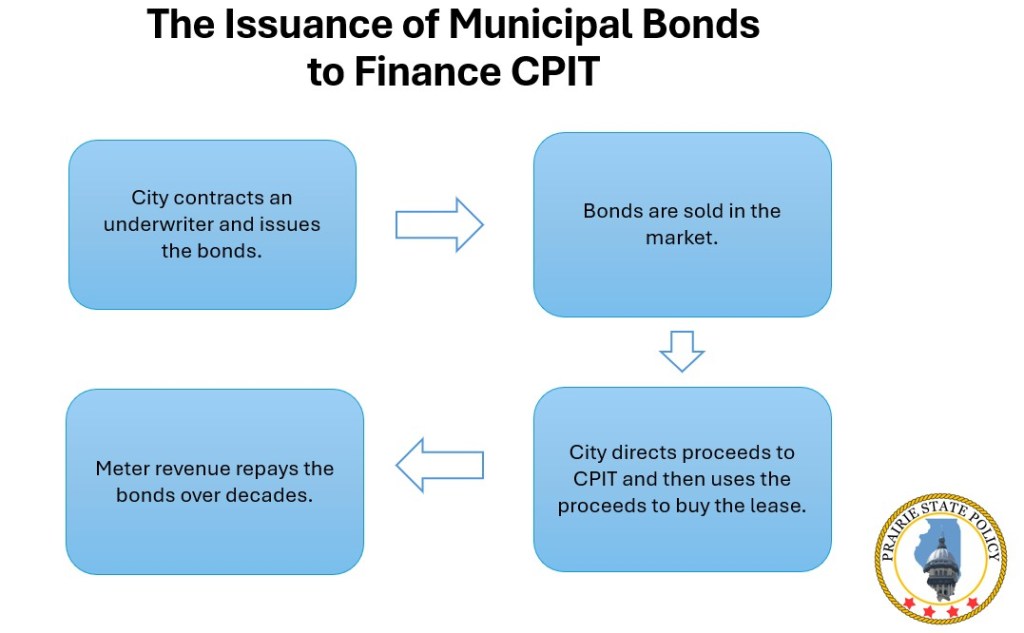
This is the most conventional approach. The PIT would issue long‑term municipal bonds backed by future parking meter revenue. Investors would be repaid from meter collections, not from the city’s general fund.
Because the debt sits on the PIT’s balance sheet rather than the city’s, Chicago avoids adding pressure to its already strained credit rating. Figure 1 below provides an over-simplification of this process.
Public Entity Partnerships
The city could invite other public institutions to invest in the trust. This model mirrors the 2015 Chicago Skyway acquisition, when three Canadian pension funds — CPPIB, OMERS, and OTPP — jointly purchased the Skyway concession for $2.8 billion, each taking a one‑third stake.
Parking meter revenue is stable and predictable, making it attractive to pension funds and other public investors seeking long‑term returns. Under this model, the PIT would retain majority ownership, ensuring public control while leveraging outside capital.
Reclaiming the parking meter system would not undo the financial consequences of the 2008 deal, but it would allow Chicago to restore a critical public asset, capture future revenue, and prevent another decades‑long privatization. The Public Infrastructure Trust model offers a path — complex, expensive, but potentially transformative — for the city to correct one of its most infamous fiscal missteps.
Discover more from Prairie State Policy
Subscribe to get the latest posts sent to your email.

